The Death of Sacred Space
Walk into any contemporary gallery today and you’ll witness something unprecedented: artists creating work explicitly designed for the 4.7-inch screen. Not adapted for it. Conceived for it. The numbers don’t lie – 78% of emerging artists now consider social media reach when developing new pieces. This isn’t selling out. This is evolution under pressure.
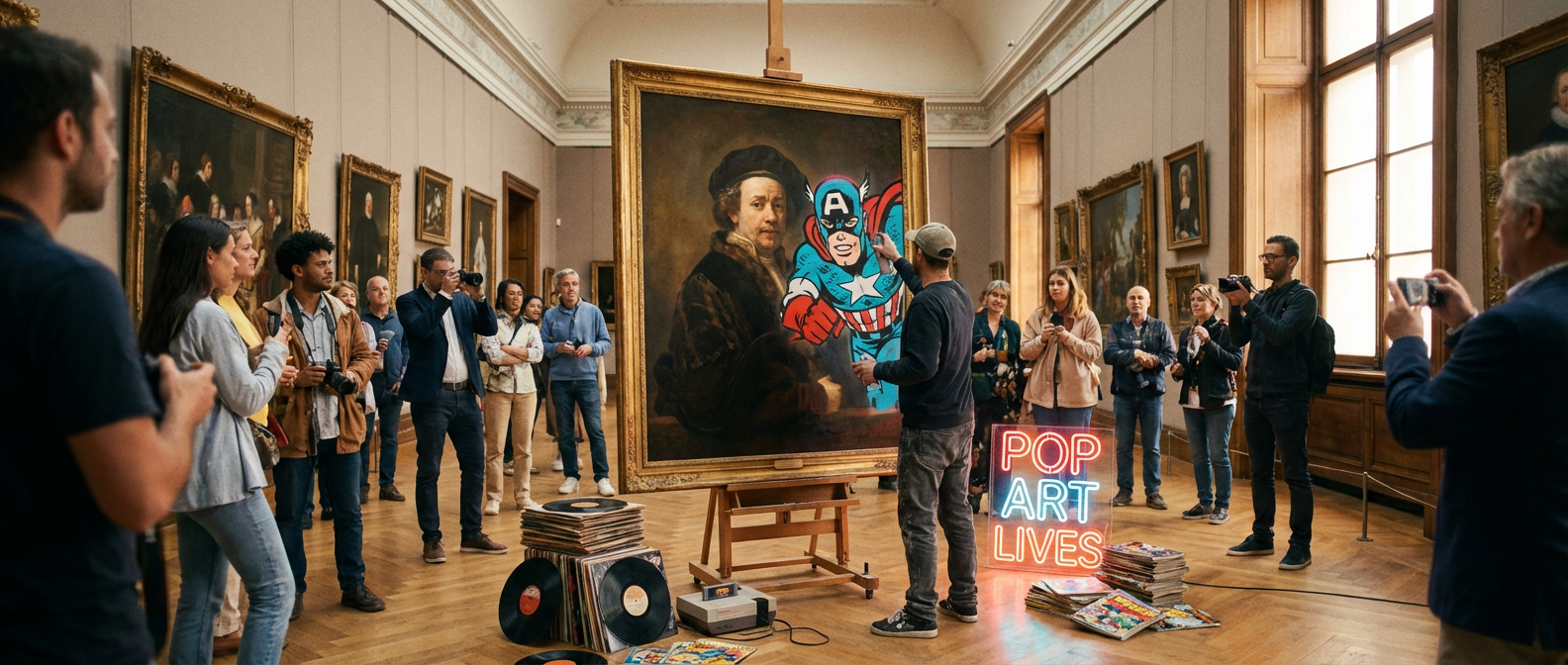
Take Kerry James Marshall’s recent switch to more saturated colors in his paintings. The artist openly admits his studio process now includes digital previews, testing how compositions read through phone cameras. It’s not pandering. It’s recognizing that most viewers will encounter his work first through Instagram stories, not gallery walls. The sacred white cube no longer controls first impressions.
This reality forces a fundamental question about artistic integrity that most critics won’t address honestly. When Takashi Murakami designs a piece knowing it will be photographed against neon gallery lighting for TikTok videos, is he compromising his vision or expanding it? The old guard screams commodification. They’re completely missing the point.
Collaborative Contamination
Pop culture isn’t just influencing fine art. It’s taking over the creative process itself through completely new collaborative structures. Look at how Beeple’s $69 million NFT sale wasn’t just about digital ownership, but about documenting 5,000 consecutive days of creative output. That’s a pop culture approach to artistic practice: daily engagement, public accountability, real-time feedback loops.
This methodology is bleeding into traditional mediums with fascinating results. Sculptor Simone Leigh now maintains detailed Instagram documentation of her bronze-casting process, sharing technical failures alongside triumphs. The audience becomes invested in the work’s development. Critics call this performative transparency, but they’re watching something more profound: the democratization of artistic knowledge that was once hoarded in graduate programs and elite ateliers.
The contamination runs deeper than documentation. Pop culture’s obsession with remixes, samples, and mash-ups has legitimized appropriation strategies that were once stuck in art school experiments. When Jeff Koons creates balloon animal sculptures, he’s operating in the same conceptual territory as a DJ layering samples. The difference is material and market, not methodology.
Speed vs. Contemplation
Pop culture operates on algorithmic time: the relentless demand for fresh content that can be consumed and discarded within seconds. This pressure is rewiring how artists approach making itself. Traditional fine art production, with its emphasis on slow contemplation and methodical craft development, now competes with the dopamine hit of immediate digital response.
Think about how this affects something as basic as color mixing. Painters like Amy Sillman have embraced iPad painting not as a replacement for oil on canvas, but as a parallel practice that feeds back into her physical work. The digital medium’s instant undo function and infinite color palette creates muscle memory that influences how she approaches pigment in her studio. It’s not replacement. It’s hybridization.
The speed imperative also transforms conceptual development. Artists increasingly work in series designed for episodic release rather than singular masterworks intended for decades of contemplation. This isn’t artistic ADD. It’s acknowledging that attention itself has been reengineered by pop culture’s rhythms. Fighting this change means creating work for an audience that no longer exists.
Materials as Media
Perhaps most significantly, pop culture is expanding what we even consider artistic materials. When Petra Cortright creates digital paintings using beauty app filters and webcam software, she’s not abandoning traditional craft. She’s extending it into territories that didn’t exist five years ago. The technical precision required to manipulate these tools rivals any classical training in perspective or anatomy.
This material expansion forces artists to become fluent in pop culture’s visual languages not as subject matter, but as raw material. Understanding how TikTok’s algorithm favors certain aspect ratios becomes as important as knowing how different canvas preps affect paint absorption. It’s technical knowledge disguised as cultural fluency.
The most sophisticated contemporary artists aren’t rejecting these new materials. They’re mastering them while maintaining connection to traditional craft principles. Ian Cheng’s artificial intelligence simulations show the same attention to compositional balance and color harmony that defines great painting, applied to machine learning systems. The medium changes. The underlying craft principles survive.
The New Authenticity
Critics who dismiss pop culture’s influence as superficial miss how it’s actually deepening artistic authenticity by destroying pretense. When an artist admits they design work for Instagram, they’re being more honest about contemporary viewing conditions than colleagues who pretend social media doesn’t exist while secretly optimizing their practice for online engagement.
This honesty extends to the making process itself. Pop culture’s emphasis on behind-the-scenes content has made artistic labor visible in new ways. Viewers now expect to see the scaffolding, understand the technical decisions, witness the failures alongside successes. This transparency doesn’t diminish artistic mystique. It moves it from personality cult to process appreciation.
The result is work that operates on both pop culture’s immediate accessibility and fine art’s deeper complexity. The best contemporary artists aren’t choosing between these approaches. They’re creating pieces that reward both casual scrolling and sustained contemplation. It’s a technical achievement that requires mastering two distinct but overlapping skill sets.
The conversation about pop culture’s impact on fine art usually focuses on market dynamics and audience reach. But the real revolution is happening in studios, where artists are developing hybrid practices that would have been impossible even a decade ago. The interesting question isn’t whether this influence is good or bad, but how it’s changing what we consider basic artistic skills. What specific techniques are you seeing emerge in your own creative practice or observation of contemporary work?
