The Magic Happens in the Margins
Forget everything you think you know about artistic purity. The most electrifying creative work happens when mediums crash into each other like particles in a hadron collider. Think David Lynch directing music videos that feel like fever dreams, or Laurie Anderson transforming performance art into sonic landscapes that rewire your neural pathways. This isn’t artistic dabbling. This is creative combustion at its most raw and honest.
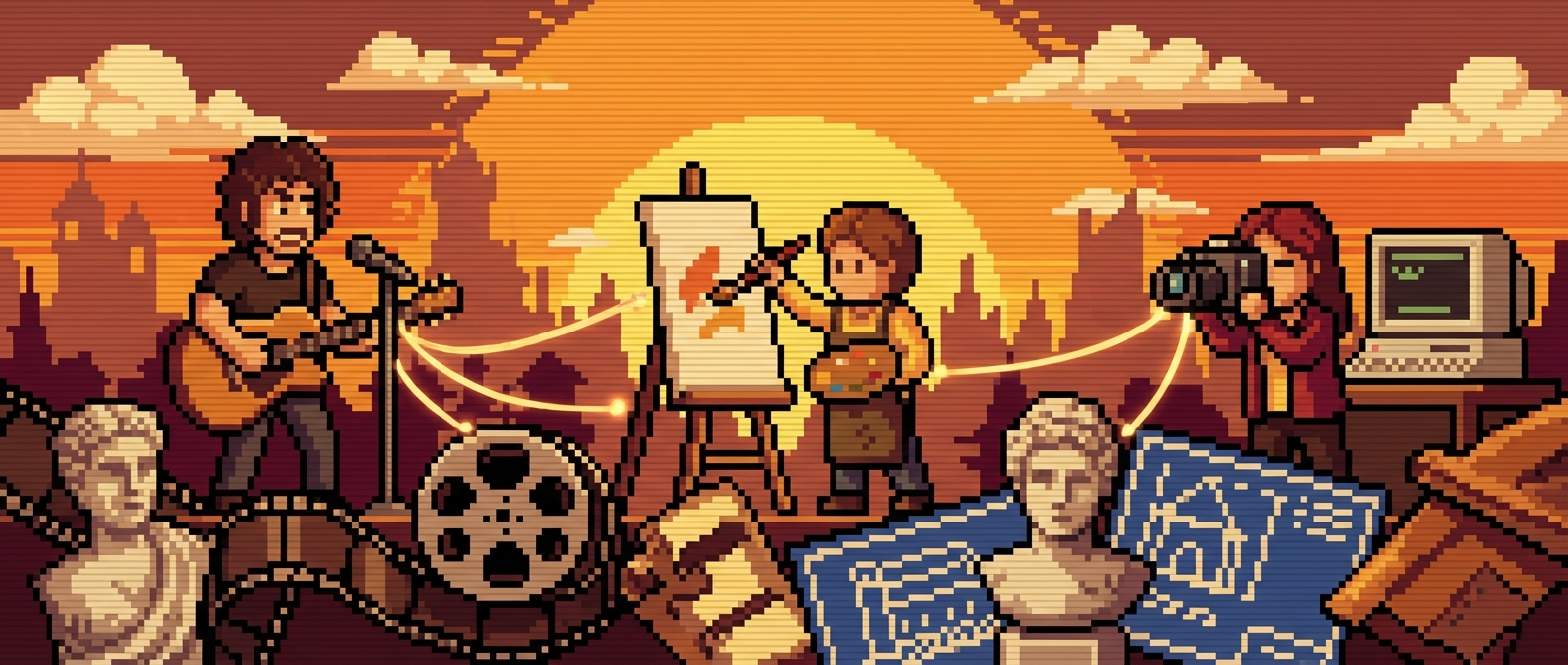
Cross-medium collaboration has been quietly changing how we experience art for decades. When filmmaker Derek Jarman painted directly onto film stock for “The Last of England,” he wasn’t just making a movie. He was tearing down the pointless walls between cinema and visual art. When Björk transforms concert halls into immersive installations with her biophilia tours, she’s proving that music can be sculpture, that sound can be architecture.
The gatekeepers want you to believe in artistic lanes. Stay in your medium. Know your place. But the most exciting work has always happened when creators refuse those boundaries. The Renaissance masters understood this. Da Vinci didn’t separate his engineering from his painting. Neither should we.
Breaking Down the Silos That Kill Innovation
Art schools build walls where none should exist. Painting students rarely touch sound design. Musicians avoid visual composition theory. Dancers ignore narrative structure. This separation is creative death by a thousand cuts. The most dynamic contemporary artists are those who consciously tear down these barriers.
Look at how Ryoji Ikeda transforms data visualization into transcendent audiovisual experiences. His installations like “Test Pattern” wouldn’t exist if he respected the fake boundaries between digital art, sound composition, and mathematical visualization. Or consider how Robert Wilson’s opera productions integrate lighting design, movement, and sound into unified sensory experiences that expand what opera can be.
These aren’t accidents or happy coincidences. They’re the result of intentional cross-training, of artists who refuse to accept that mastering one medium means ignoring others. The future belongs to creative polymaths who can speak multiple artistic languages fluently.
The Technical Renaissance Happening Right Now
We’re living through the most democratized period of creative tool access in human history. Digital audio workstations that once cost thousands are now free. Video editing software runs on phones. Virtual reality creation tools are open source. This technological convergence is enabling collaborations that were impossible just a decade ago.
Motion capture technology originally designed for film now allows dancers to control live musical parameters through movement. Machine learning algorithms trained on visual patterns generate musical compositions. 3D printing transforms digital sculptures into physical installations that cast shadows programmed to change with musical beats. These aren’t gimmicks. They’re new vocabularies for creative expression.
But technology is just the enabler. The real revolution is happening in how artists think about their practice. Experimental musician Holly Herndon trains neural networks on her own voice to create AI collaborators. Visual artist Refik Anadol feeds architectural data to algorithms that generate immersive visual experiences. They’re not using technology to automate creativity. They’re expanding what creativity can include.
Finding Your Collaborative Tribe
The romance of the solitary genius is a myth that actively hurts creative development. The most innovative work emerges from collision and conversation between different artistic perspectives. Building relationships across mediums isn’t networking. It’s creative survival.
Start small and specific. If you’re a photographer, spend time with musicians who understand how rhythm works. If you’re a writer, collaborate with visual artists who think spatially about narrative. Attend interdisciplinary festivals like Ars Electronica or ISEA, where technologists and artists mingle without pretension. Join online communities where experimental creators share work-in-progress documentation.
The goal isn’t to find people who validate your existing approach. It’s to find collaborators who challenge your assumptions about what your medium can do. The best creative partnerships happen when artists push each other beyond their comfort zones into territories neither could reach alone.
Starting Your Own Cross-Medium Experiments
Begin with curiosity, not ambition. Pick an artistic medium you’ve always admired but never attempted. Spend a month learning its basic vocabulary. Don’t aim for mastery. Aim for literacy. A painter learning musical scales isn’t trying to become Beethoven. They’re expanding their understanding of rhythm and repetition that might transform how they approach visual composition.
Document everything. Cross-medium experimentation generates unexpected connections that only become clear in retrospect. Keep notebooks, record voice memos, save screenshots of inspiring work. The patterns will emerge if you pay attention to them.
Accept productive failure. Most experiments won’t work. That’s not the point. Each failed collaboration teaches you something about the boundaries and possibilities of different mediums. What feels natural to a dancer might feel foreign to a filmmaker, and that friction creates opportunities for discovery.
The most important thing is to start. Pick up that camera if you’re a musician. Learn basic coding if you’re a visual artist. Write poetry if you’re a choreographer. The creative future belongs to artists brave enough to be beginners again, who understand that the most interesting work happens when familiar tools meet unfamiliar minds.
