The Court Decision That Shook the Art World
Let’s be direct: the U.S. Court of Appeals just handed down a ruling that should matter infinitely more than it will to most people scrolling through Instagram. In 2025, the court reaffirmed what seemed obvious to anyone paying attention—AI-generated images cannot hold copyright protection under the 1976 Copyright Act. This built directly on the earlier Thaler v. Perlmutter precedent, which had already established that works created without human authorship fall outside our legal framework for creative protection. The ripple effect? Approximately 15,000 pending copyright applications are now in limbo, rejected, or facing serious scrutiny.

Here’s where it gets interesting. This isn’t a technicality tucked into patent law. This is the foundational architecture of how we legally recognize creative work. For centuries, copyright has been built on a simple proposition: humans make things, and those things deserve protection from unauthorized copying. The Thaler v. Vidal decision doesn’t reject that proposition. It weaponizes it. If a machine generates the image, there is no author. There is no creativity in the legal sense. There is only an output.
The Gray Zone That’s Actually the Problem
But here’s where the ruling gets genuinely complicated, and where I suspect most artists haven’t yet grasped the full implications. The Copyright Office released guidance in February 2025 stating that works requiring “more than de minimis human authorship” remain protectable. Translation: if you used AI as a tool but made substantial creative decisions, you might still have copyright coverage. The word “might” is carrying most of the weight in that sentence.
We’re now operating in a legal fog. What counts as “more than de minimis”? Is it substantial if you write a detailed prompt to an AI image generator and then use Photoshop to modify 20 percent of the result? Fifty percent? What if you generate dozens of variations and select the one that resonates with your vision? The Copyright Office hasn’t provided granular thresholds, which means we’re heading toward years of litigation where individual artists will become test cases. Some will win. Others will spend six figures in legal fees to find out their work isn’t protected.
The Adoption Problem That Nobody’s Discussing
Here’s the truly unsettling data point: Adobe’s 2025 Creative Trends report reveals that 58 percent of professional illustrators are now integrating some form of AI-assisted tool into their workflow. Two years ago, that number was 31 percent. That’s not adoption. That’s capitulation.
What’s driving this? Simple economics. A freelance illustrator who used to spend eight hours on a complex background can now spend two hours generating variations with AI, selecting the strongest option, and refining it manually. The work is faster. The client expects faster. The competition is using AI. Suddenly, not using it becomes a business liability. This is what happens when technology offers efficiency that the market immediately commodifies. It’s not that illustrators wanted to become prompt engineers. It’s that the alternative, getting priced out, became unacceptable.
But here’s what Adobe isn’t advertising: this adoption creates legal liability. Those illustrators are now operating in uncertain terrain. If they incorporate AI-generated elements into their work, do they need to disclose it? Is their entire portfolio suddenly vulnerable to copyright challenges? The Thaler v. Vidal decision creates zero clarity on these questions.
The Political Pressure That’s Actually Building
In January 2025, the Artists Rights Alliance, representing over 12,000 visual artists, filed a formal petition to Congress requesting a dedicated legislative framework specifically addressing generative AI and artistic creation. This isn’t a symbolic gesture. This is 12,000 working artists saying: the courts have ruled, but the law is broken, and we need Congress to fix it.
The petition is substantial. It addresses training datasets scraped without consent, the need for mandatory disclosure when AI-generated content is presented for sale, and the economic reality that widespread AI adoption is devaluing creative labor at an unprecedented speed. What’s particularly sharp is the alliance’s argument that we’ve solved this problem before. When photography emerged in the 1800s, there was existential panic about painting. The solution wasn’t to ban photography or declare photographs non-copyrightable. The solution was to acknowledge photography as a legitimate creative medium and establish legal protections for photographers. We need something similar for AI-assisted art.
Will Congress listen? That’s another question entirely. The Copyright Office maintains a dedicated resource at U.S. Copyright Office AI Policy that’s being updated with noticeable frequency, which suggests the government recognizes this as an active problem area. Whether that translates into actual legislation is a different matter.
The Christie’s Sale That Proved the Market Doesn’t Care
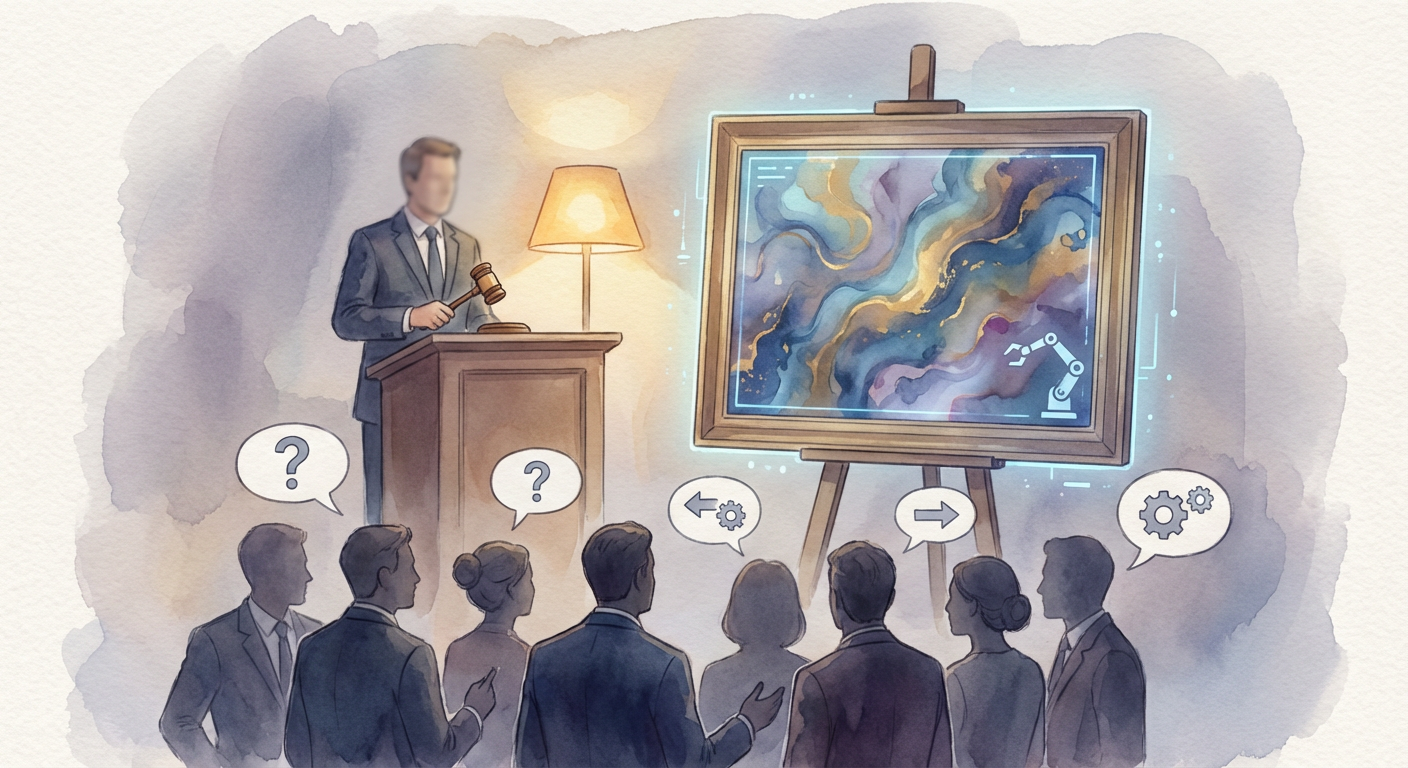
In March 2025, Christie’s sold an AI-assisted artwork for 2.1 million dollars. Not a provocative six-figure piece. 2.1 million. This happened under a new disclosure framework requiring auction houses to identify when AI was involved in creation, which technically represents accountability. In practice, it proved something darker: disclosure changes nothing about market valuation. The work sold for what it sold for because collectors believed it was valuable, the provenance checked out, and the artist’s reputation held weight. The fact that AI touched the creation process was disclosed and irrelevant.
This Christie’s sale matters because it reveals the actual fracture in the art world. The legal system is drawing hard lines: AI-generated content isn’t copyrightable. The market is drawing different lines: AI-assisted content can be worth millions if the artist has sufficient reputation and the story is compelling enough. Meanwhile, working illustrators and visual artists are trying to navigate both systems simultaneously, which is like being asked to follow two different maps to the same destination.
The Thaler v. Vidal decision was supposed to settle something. Instead, it’s clarified exactly how unsettled everything actually is. We’ve got a court ruling that says one thing, Copyright Office guidance that creates exceptions, professional adoption rates that are accelerating, industry pressure demanding legislative action, and a market that’s pricing AI-assisted work at museum-acquisition levels. That’s not resolution. That’s a system in full tension.
What’s your read on this? Are you an artist navigating these waters yourself? Have you changed your workflow, your contracts, or your disclosure practices based on this ruling? The debate isn’t over. Honestly, it’s just getting started.
