The Mouse That Roared Against Digital Delusion
On February 28, 2026, the art world woke up to find its digital pretensions splattered across a Shoreditch wall. Banksy’s latest provocation, ‘Right-Click Save As’, shows everything wrong with our collective NFT fever dream in one devastating image: a computer cursor poised to steal da Vinci’s masterpiece with the casual indifference of a teenager downloading pirated music.
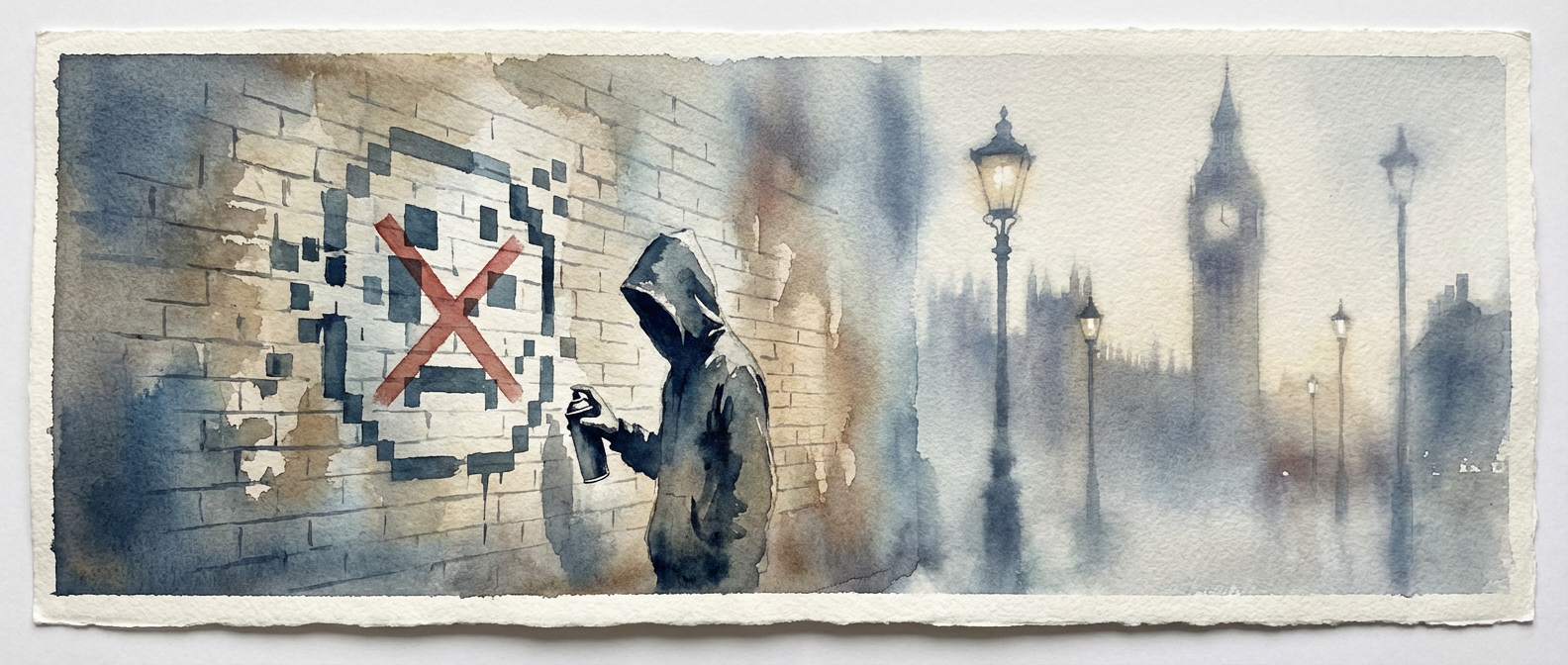
The timing couldn’t be more brutal. Here we are, three years after the NFT bubble burst like a punctured Damien Hirst spot painting, and Banksy delivers this surgical strike against our wounded digital hubris. The piece features Leonardo’s Mona Lisa trapped within a browser window, her enigmatic smile now mocking every collector who ever paid six figures for a pixelated ape.
This isn’t just street art. It’s an autopsy performed on the still-warm corpse of crypto art culture. While galleries still whisper about blockchain permanence and digital scarcity, this mural screams the obvious truth: everything can be copied with two clicks.

The QR Code Manifesto That Broke the Internet
But here’s where Banksy’s genius truly unfolds. Embedded within the mural sits a QR code, accessible to anyone with a smartphone. No gallery admission. No VIP preview. No cryptocurrency wallet required. Scan it, and you’re transported to a manifesto that 890,000 people have already devoured, a number that grows by the hour.
The manifesto itself reads like a love letter to analog rebellion, systematically dismantling every argument crypto evangelists used to justify their digital gold rush. Banksy doesn’t just critique NFT culture; he eviscerates it with the kind of intellectual precision that made “Girl with Balloon” more culturally significant than any Bored Ape variant ever produced.
What makes this QR code revolutionary isn’t its technology but its accessibility. While NFT collectors locked their “investments” behind blockchain gates and Discord servers, Banksy threw open the doors to genuine artistic discourse. The result? Nearly a million people engaging with art criticism in real time, proving that meaningful cultural conversations don’t need smart contracts to go viral.
When Authenticity Becomes Irony
The delicious irony deepened on March 3 when Pest Control Authentication Statement confirmed the work’s legitimacy. Overnight, the building’s value exploded by £2.4 million, creating the kind of instant wealth that NFT promoters always promised but rarely delivered. The authentication transformed bricks and mortar into liquid gold faster than any smart contract ever could.
Consider the cosmic joke here: Banksy’s anti-commodification statement immediately becomes a commodity worth more than most people’s homes. The artist who built a career questioning artistic value creates value through that very questioning. It’s performance art disguised as street art disguised as market manipulation. And it’s absolutely brilliant.
Street art dealer John Brandler’s valuation of £8-12 million for the wall section only amplifies this paradox. The building owner’s refusal to sell adds another layer of meaning. Here’s physical art that can’t be right-clicked, saved, or transferred to a digital wallet, yet it’s worth more than entire collections of “rare” NFTs that crashed harder than the Hindenburg.
OpenSea’s Sunken Dreams and Analog Revenge
The mural’s timing coincides perfectly with NFT culture’s spectacular implosion. OpenSea, once the crown jewel of digital art trading, watched its valuation plummet from $13.3 billion to $1.8 billion between 2022 and 2025. The OpenSea Market Analysis Report 2025 reads like a financial obituary, documenting the systematic collapse of everything blockchain boosters promised would revolutionize creative ownership.
Banksy’s cursor hovering over the Mona Lisa becomes a perfect metaphor for this digital disillusionment. Every right-click represents the fundamental flaw in NFT logic: artificial scarcity in an infinitely copyable medium. While crypto artists tried to recreate the Renaissance masters’ exclusivity through code, they forgot that true artistic power comes from cultural resonance, not technological barriers.
The collapse wasn’t just financial. It was philosophical. NFTs promised to democratize art ownership but instead created new forms of digital feudalism. Wealthy collectors hoarded JPEGs behind blockchain walls while actual communities got priced out of cultural participation. Banksy’s mural reverses this dynamic, offering free access to artistic meaning while creating real-world value through physical presence.
The Plot Twist That Redefined Artistic Rebellion
What makes ‘Right-Click Save As’ the art world’s biggest plot twist isn’t just its anti-NFT stance. It’s how Banksy weaponized the very technologies that crypto culture worships against their own ideology. The QR code, blockchain’s cousin in digital convenience, becomes a portal to analog authenticity. The mural exists simultaneously as street art, social media phenomenon, and economic disruption.
This piece forces uncomfortable questions that galleries and auction houses have been dodging since Christie’s first NFT sale. If art’s value comes from scarcity, why do Banksy’s freely shared images carry more cultural weight than million-dollar CryptoPunks? If ownership matters most, why does this ownerless wall generate more meaningful discourse than privately held digital collections?
The art world needed this wake-up call. While institutions chased blockchain trends and artists minted their souls into smart contracts, we forgot that great art has always been about human connection, not technological innovation. Banksy’s mural doesn’t just critique NFT culture, it offers an alternative vision of how art can engage with digital technology without surrendering its physical soul.
The real plot twist? Maybe the future of art isn’t digital after all. Maybe it’s standing on a Shoreditch street corner, smartphone in hand, participating in the kind of immediate, democratic artistic experience that no amount of blockchain coding can replicate. What do you think happens when the revolution comes with spray paint instead of smart contracts?
