The Numbers Don’t Lie, But They’re Not Telling the Whole Story
Christie’s March 2026 “Artificial Minds” auction didn’t just break records. It obliterated them. $312.4 million in sales, with AI-generated works making up 60% of lots sold. Refik Anadol’s “Quantum Memories” alone commanded $47.2 million, setting a new benchmark for AI-assisted art. These aren’t flukes or market bubbles. They’re massive shifts that expose how completely unprepared the art world has been for this moment.
But here’s what nobody wants to admit: we’ve been obsessing over the wrong questions entirely. While critics debated whether AI could create “real” art, collectors were already voting with their wallets. The Christie’s AI Art Market Report 2026 reveals something far more interesting than market enthusiasm. It reveals our collective confusion about what authenticity even means in 2026.
Authentication Theater and the Blockchain Bandaid
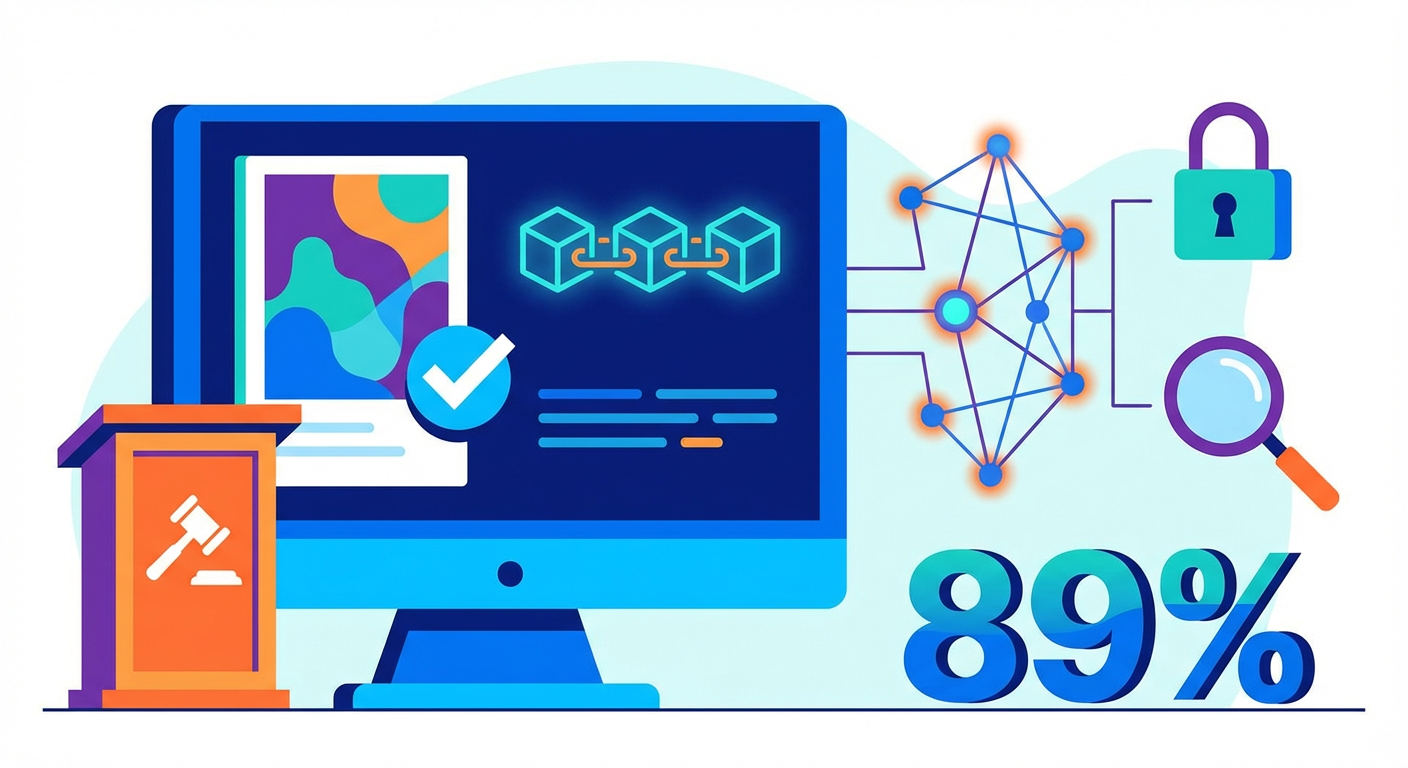
Christie’s response to authenticity concerns? Blockchain verification for 89% of AI works. It’s a techno-solution to a philosophical problem, and it misses the point spectacularly. The Blockchain Art Authentication Standards might timestamp when an algorithm generated output, but they can’t timestamp when creativity occurred. Was it when the artist conceived the prompt? When they curated the results? When they hit enter?
This isn’t about preventing forgeries. Traditional authentication worried about someone copying Picasso’s brushstrokes. AI authentication grapples with questions that would make Duchamp’s readymades seem quaint by comparison. If an artist uses AI to generate 10,000 variations and selects three, are we authenticating the selection process or the generation process? The blockchain can verify the metadata, but it can’t verify the creative intent.
The Art Basel survey showing 73% of collectors now consider AI provenance documentation essential reveals something troubling. We’re creating bureaucratic theater around creativity. Documentation requirements that would have strangled the Dadaists, the Abstract Expressionists, or any movement that challenged conventional notions of artistic practice.
The Marcus Webb Case Changes Everything
Marcus Webb’s successful $2.1 million lawsuit over undisclosed AI assistance in a 2025 painting is the legal system catching up to market reality in the most backwards way possible. Webb argued he was defrauded because the artist didn’t disclose using AI for preliminary sketches. The precedent is now set: AI assistance requires disclosure, but nobody can agree on where the disclosure threshold begins.
This ruling treats AI like a performance-enhancing drug rather than what it actually is: another tool in the artist’s arsenal. Should painters disclose their use of manufactured pigments? Should sculptors disclose power tools? The Webb case establishes a legal framework that fundamentally misunderstands the nature of artistic creation in the digital age.
More importantly, it reveals the market’s desperate attempt to maintain familiar categories in an environment that has rendered those categories obsolete. We’re trying to squeeze new wine into old wineskins, and the results are predictably messy.
What Authenticity Actually Means Now
The traditional art world’s authentication model assumed scarcity and individual authorship. A painting existed as a unique physical object created by a single human hand. AI art explodes both assumptions. “Quantum Memories” exists at the same time as code, as process, and as multiple potential outputs. Anadol’s authorship lies not in manual execution but in conceptual framework and curatorial decision-making.
This isn’t degraded authenticity. It’s expanded authenticity. When collectors pay $47.2 million for “Quantum Memories,” they’re not buying a traditional art object. They’re buying into a new paradigm where authenticity comes from conceptual rigor rather than manual labor. The work’s value lies in Anadol’s ability to harness algorithmic processes to create something genuinely unprecedented.
But the market’s insistence on blockchain verification and disclosure requirements suggests deep discomfort with this shift. We’re trying to impose industrial-age authentication methods on post-digital art forms. It’s like trying to authenticate a performance by cataloguing the theater’s floorboards.
The Real Revolution Isn’t Technology
Christie’s $312 million success story isn’t really about AI art gaining market acceptance. It’s about the art world finally confronting questions it has avoided for decades. What makes something authentic? Who gets to call themselves an artist? How do we value creativity in an age of infinite reproducibility?
These questions predate AI by generations. Walter Benjamin wrote about mechanical reproduction in 1935. Conceptual artists challenged authorship assumptions in the 1960s. Digital artists have been navigating authenticity questions since the 1980s. AI art isn’t introducing new problems. It’s making existing contradictions bigger until they become impossible to ignore.
The real change isn’t technological advancement. It’s the market finally acknowledging that authenticity was never about the artist’s hand touching canvas. It was always about the artist’s mind engaging with possibility. AI art just makes that engagement visible in ways that traditional art criticism hasn’t learned to recognize yet.
So what do you think? Are we witnessing the democratization of creativity or the commodification of algorithms? Because this conversation is far from over, and the stakes keep getting higher.
